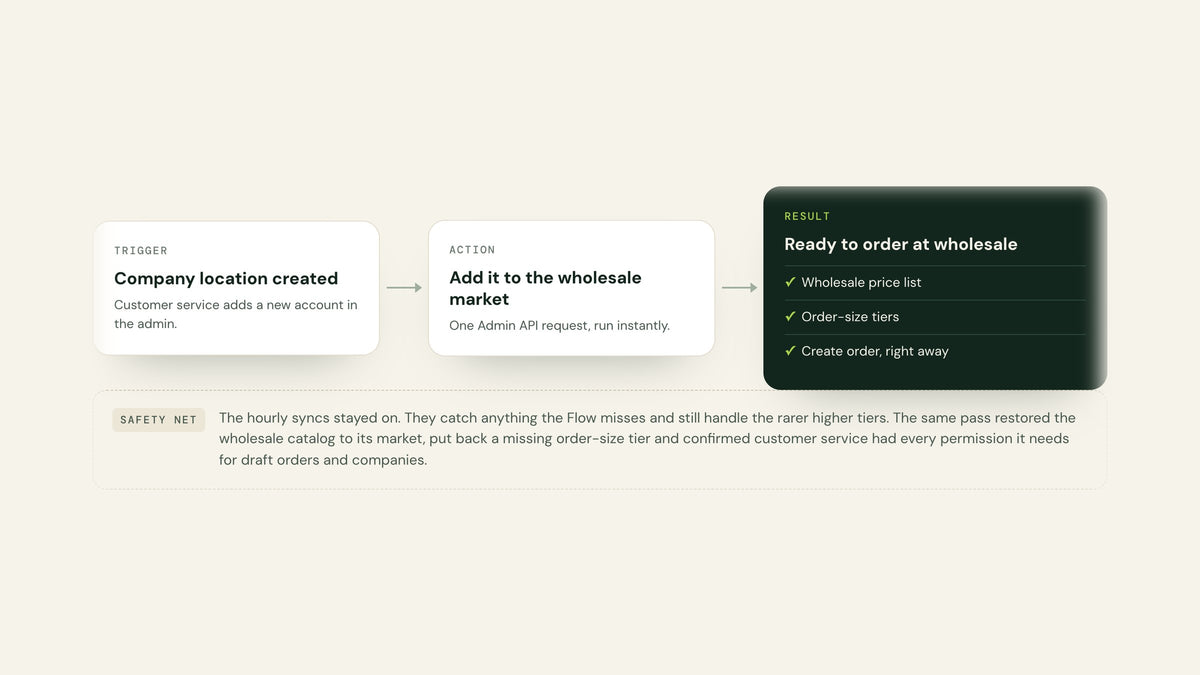
At King Bio, a new wholesale account waited on an hourly sync for its pricing. Will built one automation, so the pricing attaches while the customer is still on the phone.
Trigger, action, result
King Bio wholesale pricingWill at King Bio, his employer. Not a Start Right client.
Live Oct 30. In a Nov 2 test, customer service added an account the way a phone order runs, and it was ready to order at the wholesale price about 30 seconds later.
Other sizes
Start here
Three workflow maps, free
Send us your business. We draw three workflow maps for it, from your own words.
“You really know how to make a grown women cry. The site looks just beautiful. Something I have wanted to tackle for a long time. Your skill level and professionalism is something to marvel at.”
Anne Willis, de la terre SkincareWebsite
“I am thrilled with the site he completed for me ahead of schedule …”
James Werning, Fox & Fiddle ProductionsWebsite
“Will, fantastic, you are amazing. Thank you so much.”
Stephen Sedmak, Shope Creek WildernessFilm
“Each time he has communicated clearly with me, completed the project ahead of time, and exceeded both mine and my clients expectations.”
Brandon Bobart, Pisgah Peaks VenturesWebsite
“Will, you really rock, like I’ve said multiple times … It truly amazes me that we’re at this point.”
Joda Williams, Human Potential InitiativesWebsite
“Will quickly assessed my aesthetic, audience, and messaging; then generated a perfectly suited website at breakneck speed after a quick survey.”
Andrew Capps, Capps ConsultingClient
“You are a gift … I can tell you’re a person with integrity.”
Anne Willis, de la terre SkincareFilm
“Showing people having a great time, this is super high priority. This is beautiful content, thank you so much.”
Billy Merritt, StarTribeWebsite
“He is, hands down, the best web developer I have ever worked with. … I can’t even name a problem that he helped me solve, because he helped me solve all the problems, literally every single problem.”
Chasity Leake, The Celestial CollectionWebsite + strategy
“It really turned out great. I get excited when I read it.”
Joda Williams, Human Potential InitiativesClient
“Where have you been all my life … it looks great.”
Anne Willis, de la terre SkincareWebsite
“Well, great work, I love the homepage, it is beautiful. … Thanks again, really good work.”
Stephen Sedmak, Shope Creek WildernessIdentity
“Before Start Right, I didn’t have an identity for my startup. … The unique business cards help me close more deals that I wouldn’t have if I didn’t have them.”
Micah Valentine, Mobile Tech RoadsideFilm
“The best part of working with you is just that you’ll really see things through to the end … I would definitely recommend anybody work with you, just because you’re brilliant, smart, hard working.”
Billy Merritt, Infinity Greens / StarTribeWebsite
“Will built me a fantastic site and was helping me tailor it to my liking every step of the way. He even took me on a tour through the background of the site and set it up in a way that makes it easy for me to go back in and tweak things if necessary.”
David Santangelo, Shmoo MediaClient
“You made a huge difference … I am grateful I was introduced to you.”
Anne Willis, de la terre SkincareLogo + website
“The logo Will designed draws in my customers; It stands out above and beyond my competitors, and most importantly, it represents who I am and what I do.”
Zyzxca Vonschondorf, Lil Bit’s Boutique & Event PlanningLogo
“The logos look amazing! … I appreciate you understanding my vision”
Punam Medina, Shakti Shanti StudioWebsite
“Wow, Will that is beautiful …. Magnificent job. Thank you”
Stephen Sedmak, Shope Creek WildernessFilm
“Will is delightful to work with and I highly recommend him if you are needing video production.”
Pam Granger Gale, Majik StudiosWebsite + strategy
“Today’s session completely blew me away. … I felt heard, supported, and creatively energized the entire time. I now feel confident moving forward with my website.”
Joda Williams, Human Potential Initiatives
Registration, Switched On Nowhere to send people on September 19, taking $195 registrations on September 27.
Return to Coherence The training page live September 19 to 20.
Two Pages and a List A rebuilt homepage body, a new assessment page and a practitioner list, all live on October 1.