

From one card to a clear first page
What should a first service website say?
Say what you do, where you work, who it is for, what happens next, and how to ask for a price or appointment.
Begin with the words that are true.
If your service business has only a business card, your first website should say what you do, where you work, who the service is for, what happens next, and how to ask for a price or appointment. Use the real words from the card as the starting point.
Then add what a customer needs before making contact: services, process, owner, useful proof, common questions, and one clear next step. Do not wait for a giant brand book. Do not fill the gaps with claims you cannot support.
The goal is not to look bigger. It is to make the real business easier to understand and contact.
Run the business card test.
Turn the few words on the card into the practical questions a customer asks before choosing a service.
- Circle the plain service words. A visitor should know the main service before learning the slogan or story.
- Write the real service area. Name only the places the business truly serves. Avoid a padded location list.
- Expand each service into questions. Ask who needs it, what is included, what affects price, and what happens after contact.
- Choose one first action. Make it specific: ask for a price, schedule a visit, or call the owner.
- Mark every missing proof item. Keep a list for real job photos, reviews, credentials, policies, and before and after examples.
Your first website should sound like the real owner, not an imaginary corporation.
What usually goes wrong
The page behaves like a larger business than the one it represents. A new service business does not need invented history, anonymous team language, or promises it has not earned. Clear, modest facts make a stronger first page than padded copy.
The card is a source, not the whole brief
A card can hold a name, service list, phone number, and short promise. It usually cannot explain who each service is for, what the visit looks like, what area is served, or what the owner needs before giving a price.
Stock is not job proof
Stock photography can help a concept show mood and page structure, but it must not be presented as the business's own work. Label it during concept review, license it correctly, and replace it with real work as the record grows.
What to check after
Open the first screen on a phone. Can a visitor name the service, location, and next step without scrolling? Tap the phone, email, and form links. Make sure each request reaches the person who will answer it.
The real Laurel Park concept case
One card, three directions.

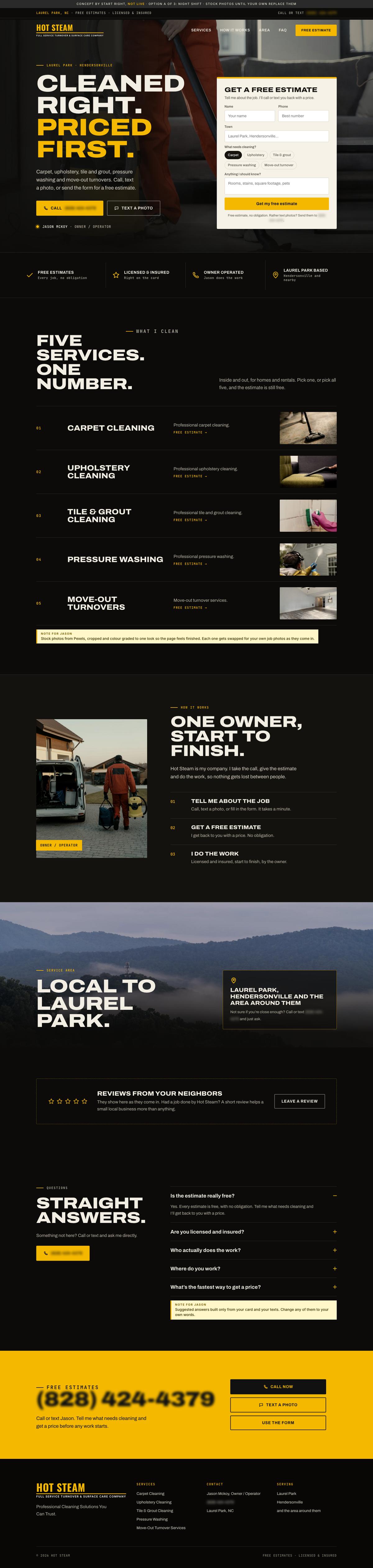
A photo of the Hot Steam business card became three full homepage concepts: Night Shift, The Work Order, and The Reveal. Together they show six whole-page renders, each direction on computer and phone. Every business fact came from the card.
The photography is paid stock, shown as concept only. None of it is presented as a Hot Steam job. This is concept proof, not a live-launch or business-result claim.
See all three concepts →Can a card be enough to start?
Yes, when it is source material rather than the finished brief. It can provide the name, core services, contact details, visual cues, and promises. The owner still needs to answer the practical questions customers ask before contacting a service business.
Should every service be on the home page?
Name the main services clearly. Give the important ones enough context to help a visitor choose. A long ungrouped list is harder to use than a short set of service paths with plain explanations.
Can I use stock photos?
Use licensed stock as a supporting visual only when it is not presented as your work. For a concept, label it. For a live service website, replace it with real jobs as useful, permissioned images become available.
Do I need separate pages immediately?
Not automatically. Start with the smallest structure that answers the customer's question and supports the next step. Add a service page when the subject needs fuller explanation, has distinct proof, or serves a meaningfully different need.
Three free concepts
Turn the card into a clear first page.
Send us your site and we draw three free homepage concepts for it, on your own page. Start Right is based in Hendersonville, serves Asheville and Western North Carolina, and Will has 19 years in the work.
Keep exploring: services and website work.